Feature store architecture gets vague when it is drawn as one large box.
That box hides the decisions that matter in production: where historical truth lives, what gets copied into a low-latency store, where feature definitions are governed, who owns freshness, and what the model serving endpoint is allowed to resolve at request time.
Before the boundaries, it helps to name the whole thing.
A feature store is a production layer for machine learning features: the input signals a model uses during training and inference. For a churn model, that might be customer tenure, failed payments in the last 30 days, product usage frequency, support ticket count or recent login activity. For a fraud model, it might be transaction velocity, device history, account age, location mismatch or previous chargebacks.
Storing those values once is the easy part. Production work starts when the same feature definition has to survive training sets, batch scoring, real-time inference, backfills, ownership, freshness and model releases.
Once the team has real feature reuse, training-serving consistency pressure, online scoring pressure, or point-in-time correctness requirements, the hard work is drawing boundaries the team can operate.
If you are still deciding whether a feature store is needed at all, start with Feature stores: what they are, when you need one, and which use cases justify them.
The useful architecture has four parts:
- offline store
- online store
- metadata contract
- serving boundary
If those boundaries are weak, the feature store becomes another data platform surface with unclear ownership. If they are explicit, it becomes a production contract between data engineering, ML engineering and application teams.
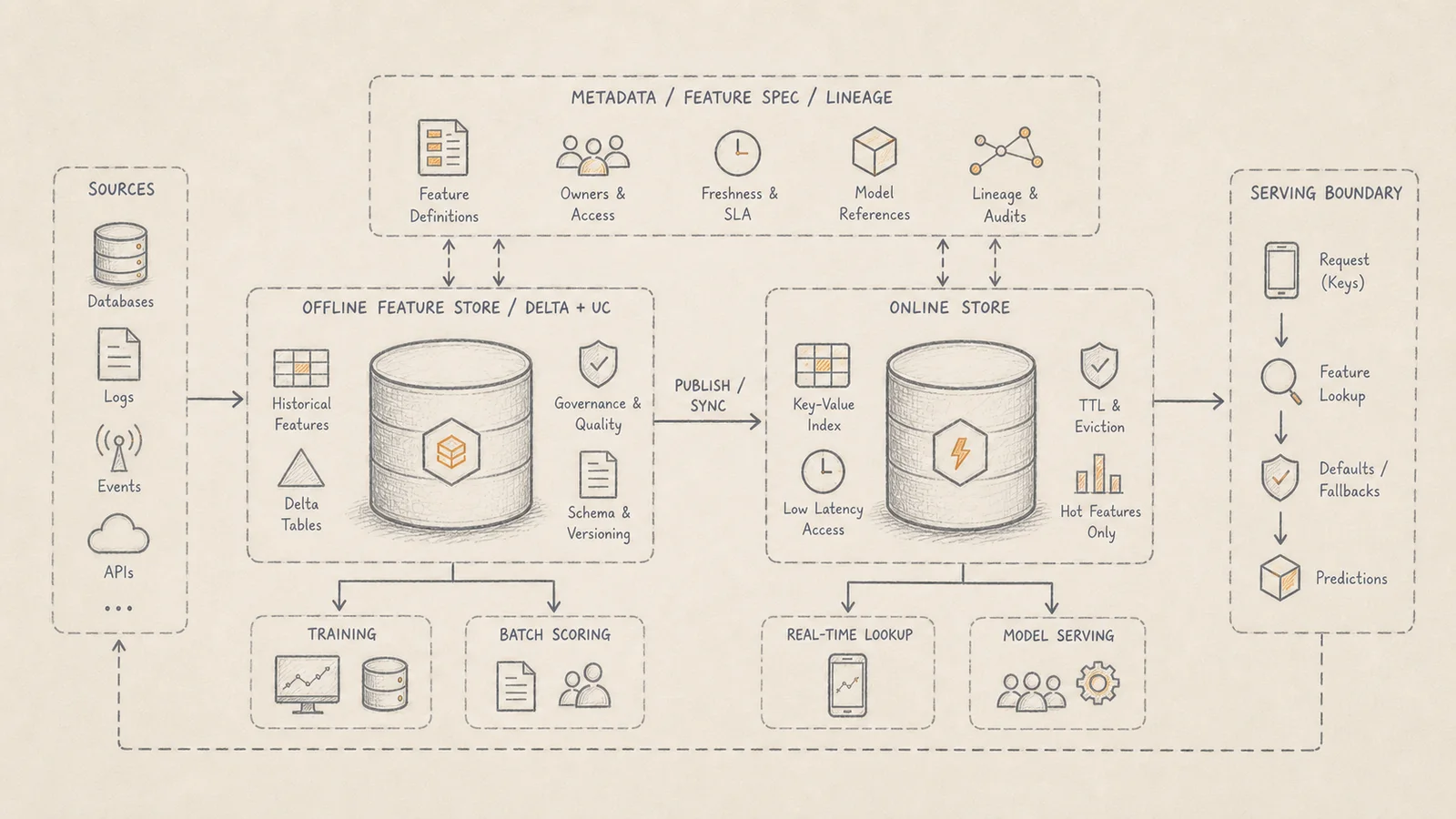
Start with feature store boundaries before tools
A feature store product gives you useful primitives. Your team still has to decide the operating model.
In Databricks, the Feature Store concepts documentation describes feature tables, training set creation, feature lookups, offline storage, online publishing, model lineage and FeatureSpecs. Those are concrete platform capabilities. The architecture work is deciding how your team uses them without blurring responsibilities.
I would start with this rule:
The offline store owns feature truth. The online store owns serving latency. Metadata owns the contract. Serving owns request behavior.
That sentence is more useful than a product diagram because it tells engineers where changes should land.
When a feature definition changes, treat it as an offline feature contract change, with backfill and downstream model impact.
When a real-time endpoint is slow, fix the serving and online lookup path instead of rewriting feature logic inside the application.
When nobody knows which models use a feature, fix metadata and lineage before adding more storage.
That separation keeps production changes in the right place.
Offline store: the source of historical truth
The offline feature store is where training and batch inference should get their feature values.
In a lakehouse design, this is usually a set of governed tables. On Databricks, feature tables are Delta tables in Unity Catalog with primary keys and feature metadata around them. The storage format helps, but the production requirement is history: the offline store must preserve enough context to rebuild training examples correctly.
The offline store has to support:
- feature computation from raw or trusted source data
- historical backfills
- training set creation
- batch scoring
- point-in-time joins for time-dependent features
- lineage from source tables to features and models
- schema and quality checks before features are published
An offline store is more than a folder of model-ready tables. It is the place where the team can answer: what did we know about this entity at that moment?
For changing features, this matters a lot. A model trained on customer behavior at t should not accidentally see activity from t + 7 days. Databricks time series feature tables handle this with timestamp-aware point-in-time lookups during training and batch inference when configured correctly. The architectural point is broader than one implementation: historical correctness belongs in the offline boundary.
Online store: a serving projection
The online store exists for low-latency lookup.
Do not let it become a second place where feature logic is invented.
The usual production pattern is: compute or materialize trusted features offline, publish the serving subset into an online store, and let serving endpoints retrieve the latest values by entity key. The Databricks Online Feature Stores documentation describes this as syncing offline Unity Catalog feature tables into an online store for low-latency access.
The online store is optimized for serving:
- key-value lookup
- low latency
- high read concurrency
- latest values
- serving availability
- capacity and cost controls
The offline store is optimized for truth:
- history
- backfills
- point-in-time correctness
- batch joins
- data quality
- governance and lineage
Mixing those roles creates bad systems. Teams start debugging model quality in the serving database. Application code starts patching feature values. Training pipelines stop matching online behavior. Nobody knows which surface is authoritative.
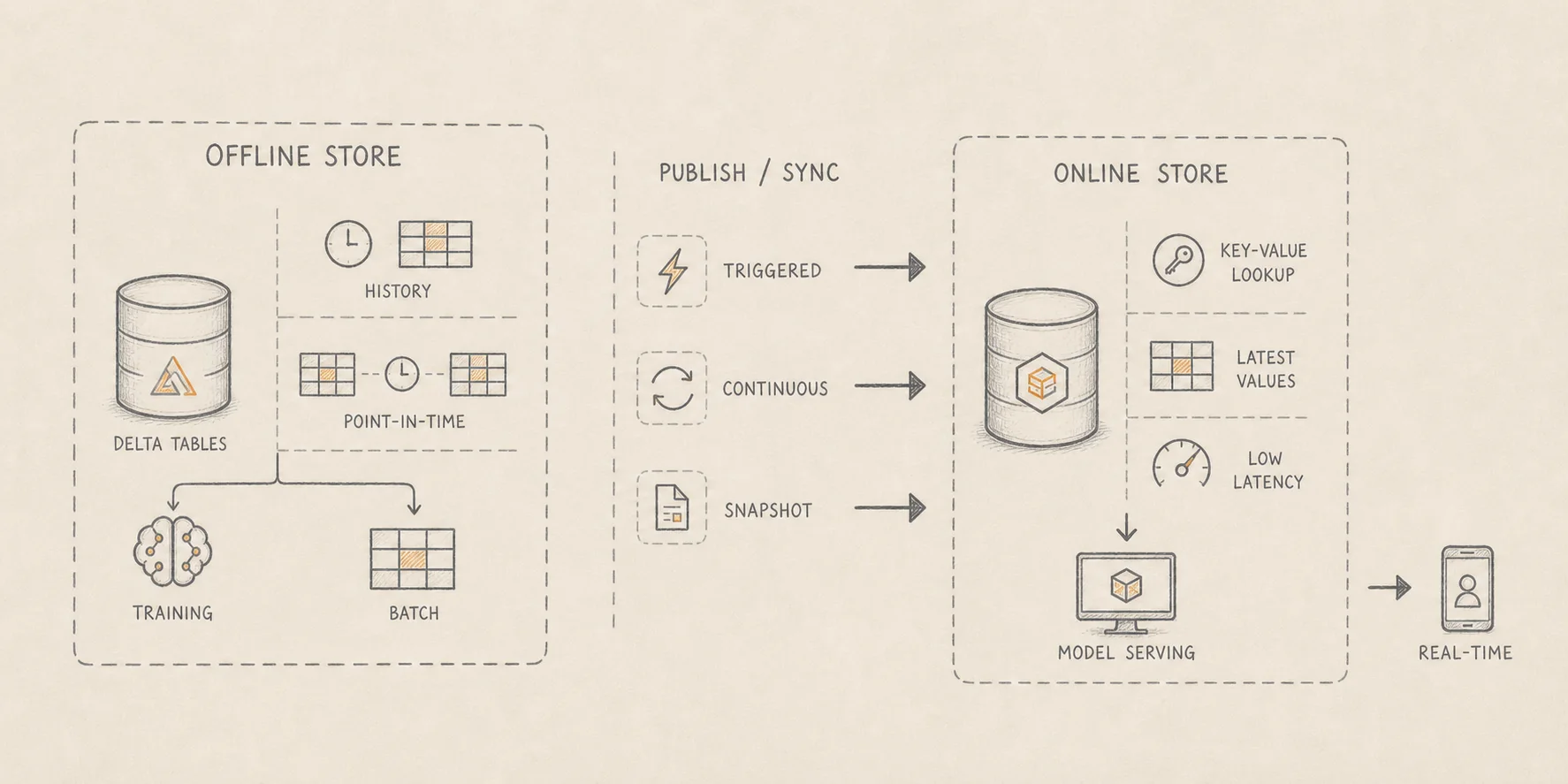
The online store should be a serving projection from offline feature truth. Feature development belongs upstream.
The publish mechanism is a real production boundary. Databricks supports publish modes such as triggered sync, continuous sync and snapshot publishing. Those choices decide how quickly online values follow offline changes, how failures are detected, and what happens during a large backfill.
For example:
- triggered sync can be enough when feature freshness is measured in minutes or hours
- continuous sync fits features that need to follow new writes quickly
- snapshot publishing is useful when a full refresh is safer than incremental movement
Pick this per feature group. Platform preference is a weak reason to give every feature the same freshness and sync pattern.
Choose the boundaries you need
Offline and online stores are separate architectural choices. Buying or building a feature store does not mean every feature has to exist in both places.
For a batch-only model, the useful boundary is often offline:
- governed feature tables
- repeatable training sets
- point-in-time correctness when time matters
- batch scoring against the same feature definitions
- lineage, ownership and freshness checks
That system may never need an online store. If predictions are generated every hour, every night or on a fixed job schedule, low-latency key-value lookup can be dead weight. The team still needs reliable features. It does not necessarily need a serving cache.
For a real-time model, the shape changes. The online store becomes useful when the endpoint has to score while the user, transaction or application request is waiting. Even then, publish only the features that need online lookup. A customer profile aggregate may belong online. A slow-changing segmentation table might be joined earlier. A request-time value such as cart value or current device state belongs in the request or an on-demand function.
For feature-heavy analytics and experimentation, a feature store can start as an offline contract plus metadata. That can be the right first step: standardize definitions, owners, backfills, point-in-time joins and reuse before adding a low-latency serving layer.
For an application that only needs a few real-time attributes, a smaller online projection can be enough. You may not need a broad feature store if the real requirement is a controlled, low-latency lookup for a narrow set of values.
Use this decision rule:
Offline is for historical correctness and reuse. Online is for serving latency. Metadata is useful in both.
The mistake is treating offline plus online as one maturity package. Match the architecture to the workload.
Metadata is the feature contract
Feature metadata is often treated as catalog polish. Production systems need more than discoverability.
A feature store metadata layer should tell engineers how a feature is defined, how it joins, who owns it, where it came from, how fresh it should be, which models use it, and what serving behavior is expected when a value is missing.
In Databricks terms, this shows up through concepts like FeatureLookup, FeatureSpec, Unity Catalog lineage and model logging with feature references. A FeatureSpec can define a reusable set of features and functions for serving, while the platform tracks lineage to offline feature tables and functions. The exact object names will differ by stack. The requirement stays the same: metadata must be strong enough to behave like an interface.
A production metadata contract should include:
- feature name and semantic definition
- owner and escalation path
- entity key or composite key
- timestamp behavior for time-aware features
- source tables and transformation lineage
- refresh cadence and freshness SLA
- null handling and default values
- expected type and schema
- allowed consumers
- models, jobs or endpoints that depend on the feature
Without that, reuse becomes risky. Engineers can discover a feature, but they cannot judge whether it is safe to use.
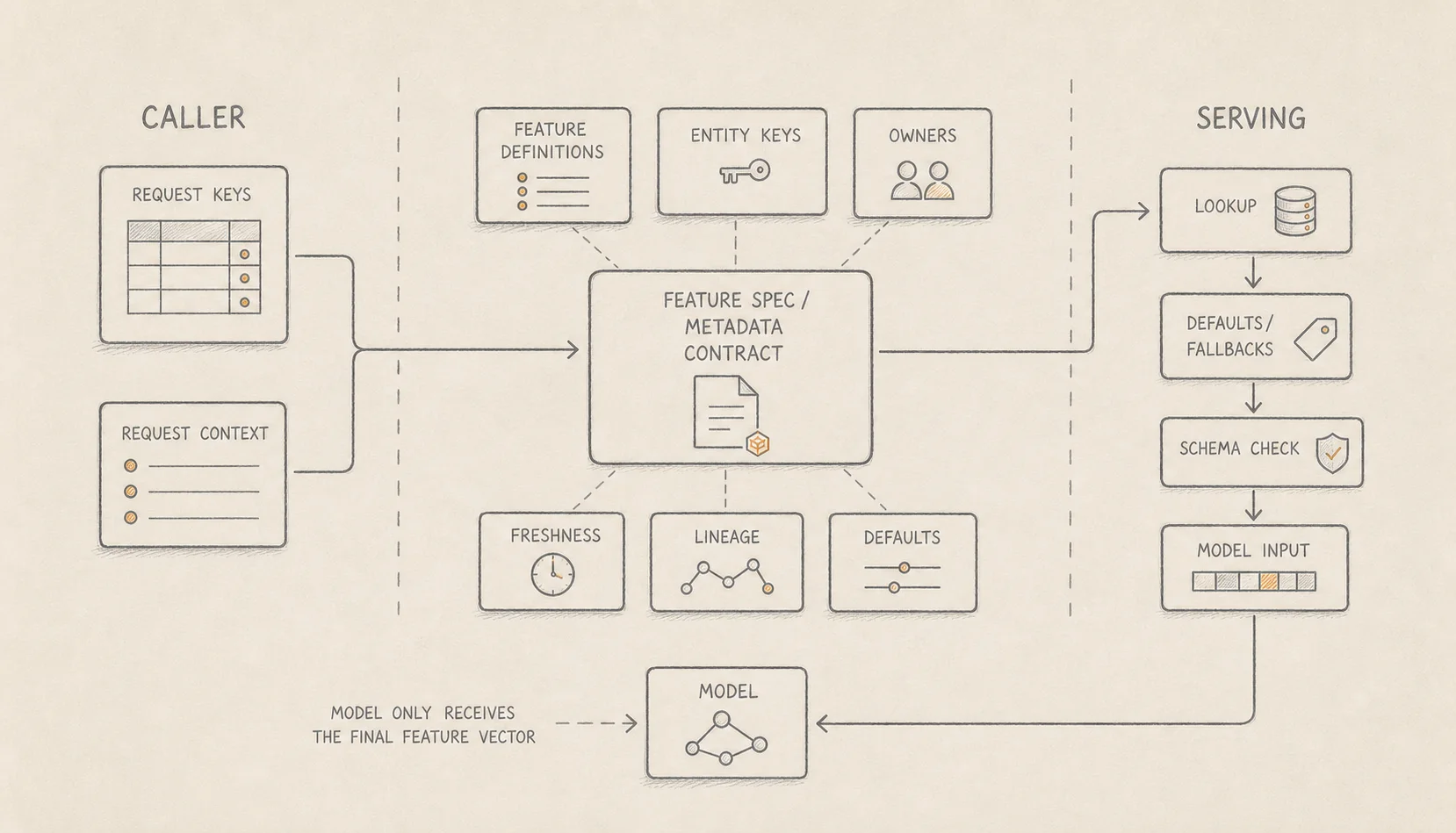
Metadata should behave like an interface: caller inputs, feature definitions, lookup keys, defaults and model inputs need explicit ownership.
The most overlooked fields are defaults and freshness.
Defaults decide what the model sees when a lookup misses. Freshness decides when a value is still valid enough for serving. Both affect product behavior and data platform behavior.
If an endpoint silently replaces missing risk features with zeros, that is a model decision. If stale customer activity remains available for twelve hours after an upstream pipeline failure, that is a product decision. The metadata layer should make those decisions visible.
Serving boundary: what the caller sends and what the platform resolves
The serving boundary is where many feature store designs become blurry.
At inference time, the caller usually sends entity keys and request-time context. The serving layer resolves stored features, computes any allowed on-demand features, applies defaults, checks schema and passes the final feature vector to the model.
The Model Serving with automatic feature lookup documentation describes this pattern for Databricks: models logged with feature references can automatically look up required feature values from online stores during model scoring. Feature overrides in the request need the same review as the rest of the serving contract.
In production, write down the responsibility split:
- the caller provides entity keys and approved request-time values
- the feature layer resolves stored features
- the serving layer handles defaults and schema validation
- the model receives the final input shape it was trained to consume
- the endpoint exposes errors, latency and lookup quality as operational signals
Request-time features need special care.
Some values only exist at inference time: current location, current cart size, session intent, current device state, or a live transaction amount. They behave differently from historical aggregates and belong in the request or in controlled on-demand feature functions.
Make that difference visible. If a feature comes from the request, call it out. If it comes from offline materialization and online lookup, call that out too. The model interface should show both paths.
Training-serving consistency is a release property
Training-serving consistency has to be validated during release. A feature store does not grant it automatically.
A production release should prove that:
- training features and serving features have compatible schemas
- online feature values are fresh enough for the serving SLO
- defaults match the assumptions used during training
- request-time columns are present and typed correctly
- point-in-time training logic does not conflict with latest-value online lookup
- model signature, feature spec and endpoint payload agree
- missing lookups are measured and visible
The last two are common sources of production pain.
A model can pass offline evaluation and still fail operationally because the serving endpoint receives a different shape from the training set. A feature can look good in backtests and still produce weak real-time predictions because the online value is stale, missing, or too often replaced by a default.
Feature store architecture has to connect to minimal viable ML observability. Start with freshness, schema, null rate, lookup hit rate, prediction distribution and latency before chasing more exotic model metrics.
Operational boundaries teams should write down
A feature store becomes production infrastructure when several teams depend on it.
Ownership has to be explicit.
For each important feature group, write down:
- who owns the feature definition
- who owns the source data contract
- who owns the transformation job
- who owns backfills
- who owns publishing to the online store
- who owns online store capacity and availability
- who owns model behavior when features are missing
- who is paged when freshness breaks
This looks bureaucratic until the first incident.
Without those answers, the application team blames model serving, the ML team blames stale features, the data team blames an upstream producer, and the platform team owns a system whose business rules it cannot safely change.
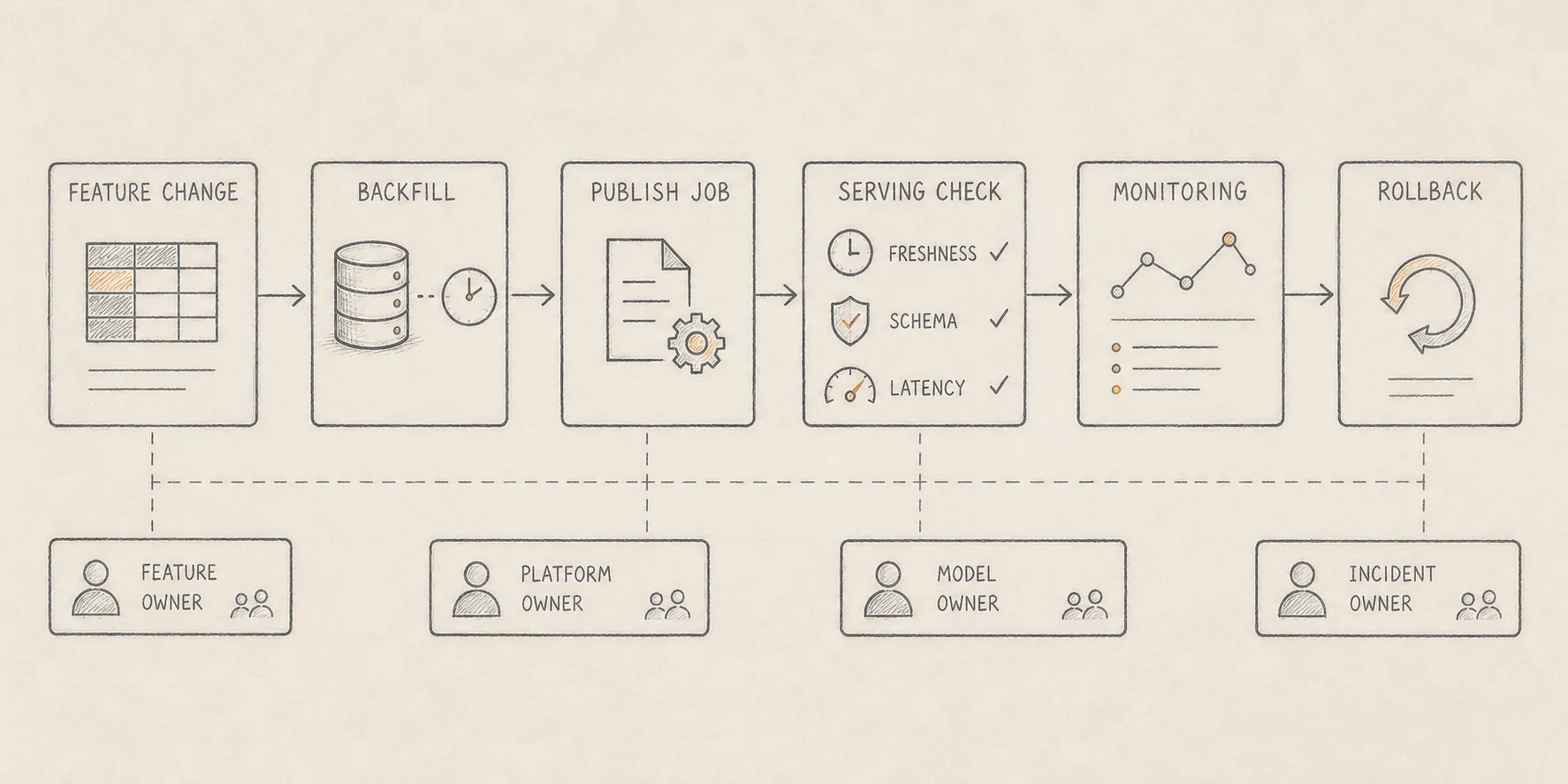
Feature store production readiness is a release flow: feature change, backfill, publish, serving checks, monitoring and rollback all need owners.
If you use Databricks Bundles or MLOps Stacks, this belongs in the standards around the generated project. The feature store boundary should be part of the same production contract as data validation, model evaluation, deployment targets and observability. That is the same operating model behind Databricks MLOps delivery patterns with GitHub Actions.
A practical architecture checklist
Before calling the feature store design production-ready, I would check it from four angles.
Offline:
- Are feature tables governed and owned?
- Are primary keys explicit?
- Are time-aware features configured for point-in-time joins?
- Can the team backfill safely?
- Are training and batch scoring using the same feature definitions?
Online:
- Which features are published online, and why?
- What freshness does each online feature need?
- Which publish mode is used?
- How are publish failures detected?
- What capacity and latency targets exist?
Metadata:
- Does every reused feature have an owner?
- Is lineage visible from source data to model?
- Are defaults documented?
- Are feature consumers visible?
- Are breaking changes reviewed before release?
Serving:
- What does the caller send?
- Which entity keys drive lookup?
- Which request-time features are allowed?
- What happens on lookup miss?
- Does the endpoint expose freshness, nulls, lookup hit rate, schema failures and latency?
This checklist is intentionally plain. If the team cannot answer these questions, the architecture is not ready for production even if the platform can deploy.
FAQ
What are the main parts of feature store architecture?
A production feature store architecture usually has four boundaries: an offline store for training and batch scoring, an online store for low-latency lookup, a metadata layer for feature contracts and lineage, and a serving boundary that defines request keys, defaults, lookups and model inputs.
What is the difference between offline and online feature stores?
The offline store is the historical source of truth used for training, backfills, point-in-time joins and batch inference. The online store is a low-latency serving projection, usually optimized for latest-value lookup by entity key during real-time inference.
Do you always need both offline and online feature stores?
No. Batch-only systems often need a strong offline feature layer but no online store. Real-time systems usually need an online projection for the hot features used at request time. The right architecture depends on scoring mode, latency, freshness, reuse and operational ownership.
Where does feature metadata belong?
Feature metadata belongs in the feature contract. It should describe definitions, entity keys, owners, freshness expectations, lineage, default values, model references and serving constraints.
What should the feature serving boundary include?
The serving boundary should define what the caller sends, which entity keys are used for lookup, which request-time values are allowed, how missing values and defaults work, which schema is enforced and what final feature vector reaches the model.
Final point
Feature store architecture works when four boundaries stay honest. Offline stores own historical truth. Online stores own low-latency serving projections. Metadata owns the feature contract. Serving owns request behavior and model input shape.
When those boundaries are explicit, a feature store can reduce production risk. When they are vague, it moves training-serving skew, stale data and ownership confusion into a more expensive part of the platform.
Further reading
- Databricks Feature Store concepts on Microsoft Learn
- Databricks Online Feature Stores on Microsoft Learn
- Feature Serving endpoints on Microsoft Learn
- Model Serving with automatic feature lookup on Microsoft Learn
- Feature stores: what they are, when you need one, and which use cases justify them
- Databricks MLOps delivery patterns with GitHub Actions
- Minimal viable ML observability: what to monitor first
- MLOps topic archive