Feature stores are one of those components that sound obviously mature until you ask what exact problem they are solving in your system.
That is why the question do I need a feature store is usually more useful than asking which product to choose.
Sometimes a feature store is the right move. Sometimes it is an expensive way to avoid fixing weaker foundations: inconsistent pipelines, poor data contracts, no shared ownership model, or too much platform enthusiasm too early.
If you want the shortest answer to what is a feature store, it is this: a feature store is a shared layer for defining, reusing and serving features consistently across training and inference.
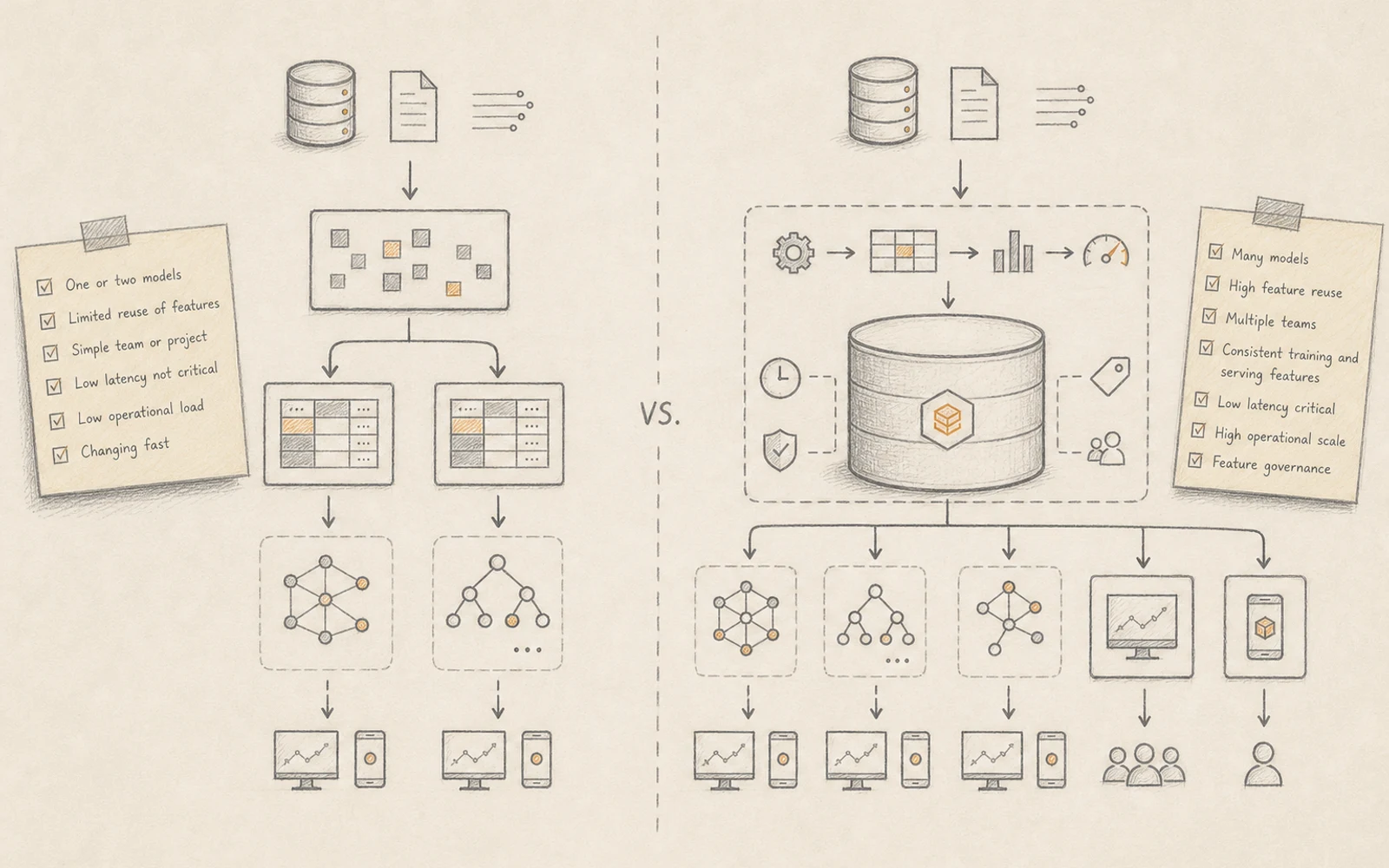
My short answer to do I need a feature store is this: you need one when feature reuse, consistency and serving requirements have become real operational problems. You do not need one just because you are doing machine learning.
That framing is also the best starting point for evaluating real feature store use cases and realistic feature store alternatives. The decision is rarely about taste. It is about architecture pressure.
If you want the broader production context around why these decisions matter after the first successful model, start with Beyond the Notebook: what has to exist before ML can run in production.
What is a feature store, really?
The most useful way to think about a feature store is not as a database and not as a magical ML platform ingredient.
It is a coordination layer around features.
The core promise is simple. A feature should be defined once, computed in a controlled way, documented, discoverable, reusable and available consistently where it is needed. That usually means some combination of:
- a shared definition of features
- lineage or ownership around those definitions
- storage for training-time access
- a path for inference-time access when low-latency serving matters
- protection against training-serving mismatch
That last point is often the one that gets the most attention, but it is not the only reason feature stores exist. In a lot of teams the bigger win is not online retrieval. It is stopping five different models from reimplementing the same feature logic in slightly different ways.
What the technical scope usually includes
This is where the term gets more concrete.
Technically, a feature store is usually a combination of a few capabilities rather than one table with a nicer name. The Databricks Feature Store concepts documentation on Microsoft Learn frames it around feature tables, lookups, training set creation, offline storage and optional online serving, which is a good mental model for the actual moving parts.
At a practical level, the architecture often includes:
- an offline layer for training and batch inference
- an online layer for low-latency retrieval in live scoring
- metadata or registry capabilities around feature definitions, lineage and ownership
- a join mechanism that pulls the right features into a training set
- some protection against training-serving skew and historical leakage
That last part matters more than people think.
The first diagram below follows the same conceptual path discussed in the Microsoft Learn documentation: offline feature computation, training, model registration, optional publishing to an online store, and runtime lookup during inference.
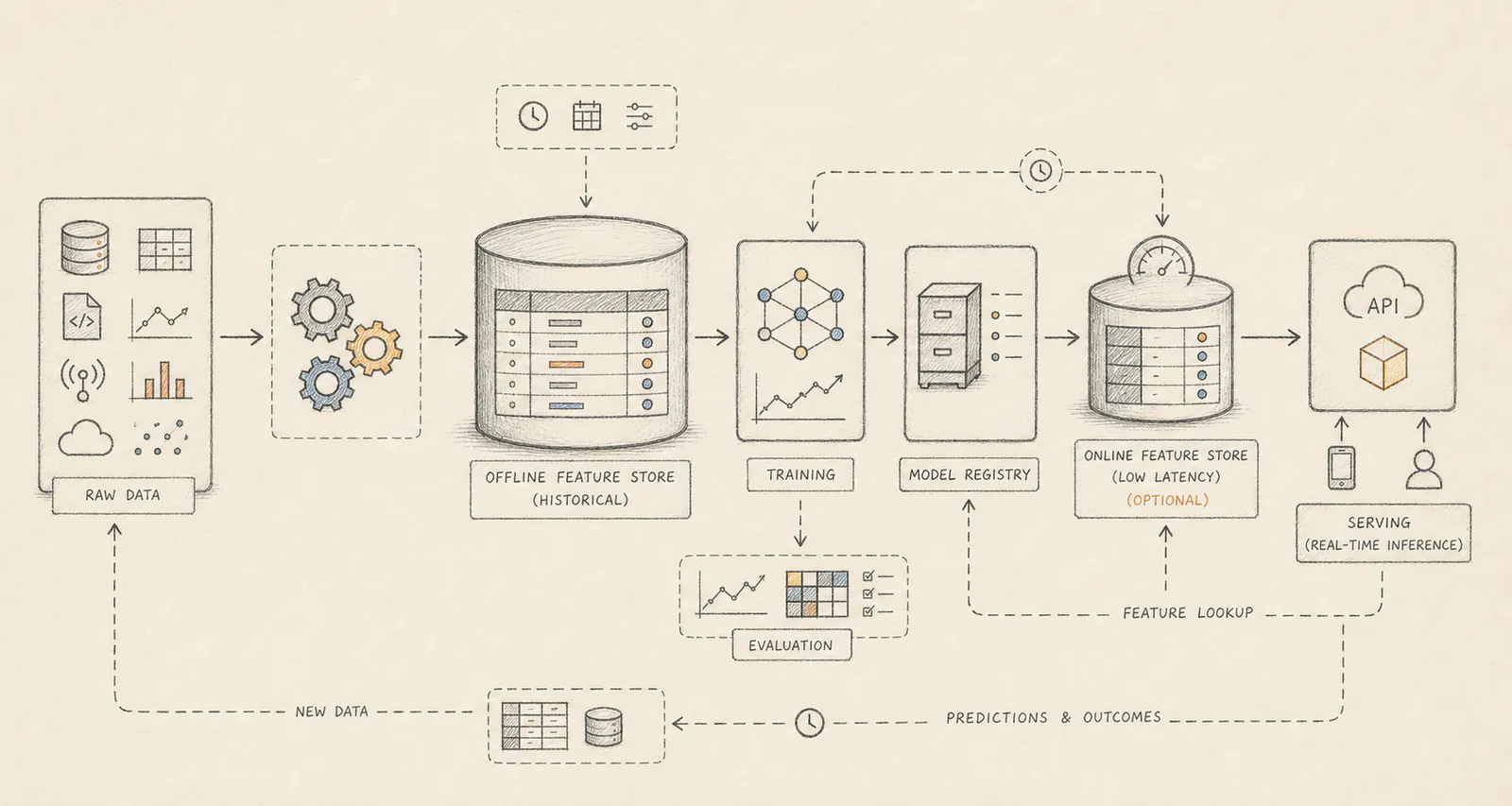
Typical feature store lifecycle: offline features support training and batch work, while an optional online layer supports low-latency inference.
For training, the system usually needs point-in-time correct retrieval. In other words, when you build a training row for customer_id = 123 at time t, you want the latest feature values that were actually knowable at time t, not values that appeared later. Databricks calls this out explicitly for time-series feature tables, because otherwise the system may join on exact timestamps or accidentally leak future information into the training set.
This is one reason feature stores start to make sense in more advanced setups. Once historical correctness, feature lineage and mixed training/serving paths become important, the abstraction is no longer just convenience. It starts protecting model validity.
In Databricks terms, this also shows up in objects like FeatureLookup and FeatureSpec. The idea is straightforward even if you do not use those exact APIs: define which features are used, how they join to entity keys, and how that feature bundle is reused during training or serving. That is a technical contract, not only a platform feature.
The Databricks blog explanation of what a feature store is emphasizes the same core point from a platform perspective: the real value is not only storage, but reliable reuse and consistency of features across the ML lifecycle.
Another technical detail that matters in practice is request-time enrichment. Some systems need a combination of precomputed features and values only known at inference time. The Microsoft Learn documentation discusses this as on-demand feature computation: the serving path merges live request context with stored features instead of pretending everything can be materialized ahead of time.
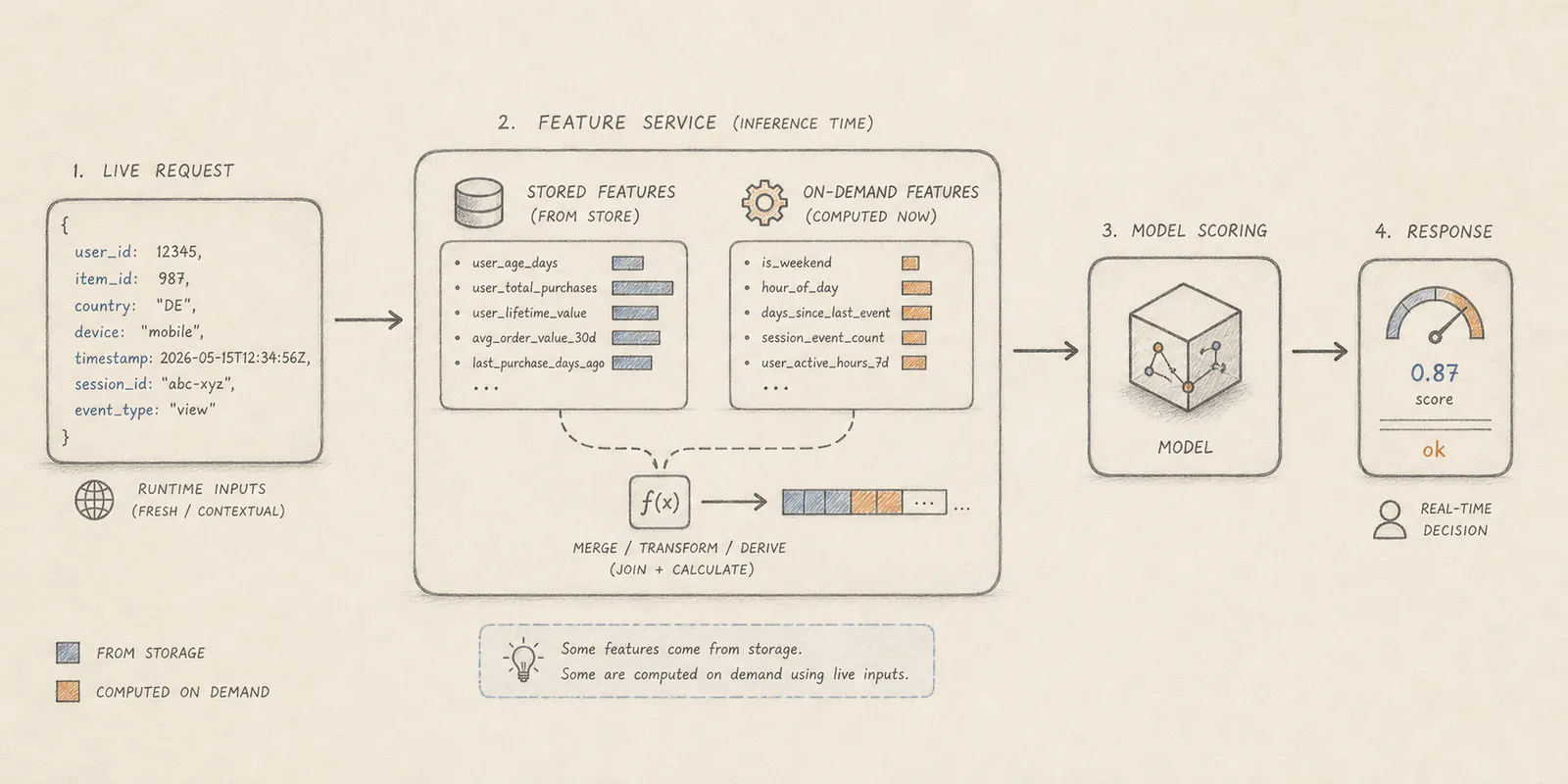
Diagram of request-time enrichment: some features are fetched from storage, while others are derived from live request context before scoring.
The popular idea is often too broad
Feature stores are frequently presented as a default step in ML maturity. The story usually sounds something like this: once the team gets serious about production ML, the next natural platform component is a feature store.
I think that framing is too broad.
A feature store is not the next mandatory box on the diagram. It is a response to a particular class of pain. If that pain is not present yet, the extra layer can create more complexity than value.
This is similar to a lot of MLOps decisions. The term sounds bigger than the underlying need. The practical question is not whether the pattern is modern. The practical question is whether the operating model around data and features is already under enough pressure to justify the abstraction.
If you want the definitional version of that broader problem, What MLOps actually is and why teams keep misdefining it is the better starting point.
When you probably do not need a feature store
Most early ML systems can live quite well without one.
If one team owns one or two models, batch inference is enough, feature reuse is limited and the feature logic still lives close to the model code, then a clean pipeline and versioned feature tables are often the better answer.
In that kind of setup, the important work is usually more ordinary:
- make transformations reproducible
- keep training inputs versioned
- make feature logic readable and testable
- define ownership for upstream data dependencies
- keep the path from raw data to model-ready data explicit
That is already a lot of engineering work. Adding a feature store too early does not remove it. It just wraps it in a heavier platform shape.
I would be especially cautious when the team mainly does batch scoring. If the model is retrained periodically, features are computed in warehouse or Spark jobs, and no low-latency online retrieval is required, the simplest useful design is often a warehouse-first one.
That can look like curated feature tables, transformation code in dbt or Spark, and explicit contracts between data preparation and modeling. It is not glamorous, but it is often enough.
The clearest signal that you might need one
The decision becomes easier when the same problems keep repeating.
One team builds a feature for churn prediction. Another team rebuilds almost the same feature for ranking. A third team implements a slightly different variant for fraud or recommendations. Now there are multiple definitions, multiple refresh cadences, multiple bugs and no clean answer to which version is trusted.
That is the moment the question changes.
You are no longer asking whether a feature store is fashionable. You are asking whether shared feature logic needs a proper operating layer.
This is the strongest signal that a feature store may start paying for itself:
- multiple models depend on overlapping feature logic
- several teams need discoverability and reuse
- training and inference use different execution paths
- point-in-time correctness is becoming non-trivial
- latency requirements make online feature access part of the design
If only one of those is true, you may still not need the extra platform. If several are true at the same time, the case gets much stronger.
Feature store use cases that are actually compelling
Some feature store use cases are much better than others.
The first compelling one is shared features across models. If customer aggregates, behavioral summaries or product interaction signals are reused across several ML systems, centralizing definition and ownership can remove a lot of duplicated work.
The second is online-offline consistency. This matters when the same feature logic has to support both training and live inference, especially when separate execution paths tend to drift. A feature store can help put stronger contracts around that boundary.
The third is discoverability and governance. Once feature count grows, teams need to know what already exists, who owns it, how fresh it is and whether it is safe to rely on. That is less exciting than low-latency serving, but often more important in practice.
The fourth is point-in-time training correctness. If training sets have to reflect what was knowable at a specific historical moment, then feature materialization and retrieval logic become more delicate. A strong feature layer can reduce leakage and inconsistency.
These are real platform problems. They justify architecture. They are not just excuses to buy another product.
Recommendation systems are a good example. User behavior aggregates, item popularity windows, session context, recent interactions and inventory or content metadata often need to be reused across several ranking or retrieval models. Those features also tend to have mixed latency requirements. Some can be batch materialized, others need fresher updates. A shared feature layer can stop every recommender workflow from building its own partial truth.
Fraud detection and risk scoring are another strong use case. Features like transaction velocity, rolling sums, geo anomalies, device history or account behavior windows are reused heavily, often need strict time awareness, and are frequently consumed both offline for retraining and online for live decisions. In that kind of system, point-in-time correctness is not academic. It directly affects whether the model is learning from realistic signals.
Personalization and decisioning systems also fit well. If web, mobile and campaign systems all need the same customer context and propensity features, then having one controlled feature layer can be much better than allowing each channel to rebuild its own version. The same applies to churn prediction, credit decisioning or supply chain forecasting when several teams depend on overlapping behavioral or operational features.
When a feature store becomes mostly ceremony
The weak use cases tend to have a different smell.
Sometimes the team wants a feature store because the platform diagram looks incomplete without one. Sometimes the real need is basic transformation reuse, but the proposed answer is a fully managed feature platform. Sometimes online serving is mentioned, but the actual product still scores in daily batches and no one has clear latency requirements.
That is usually a sign that the abstraction is ahead of the workload.
You can also spot trouble when the feature store is expected to solve organizational issues by itself. It will not create ownership. It will not fix undocumented business logic. It will not make bad upstream contracts trustworthy. It will not automatically make features reusable if teams still prefer custom one-off pipelines.
This is why feature stores can disappoint. They are often asked to fix problems that are really about engineering discipline and operating model.
Feature store alternatives that are often enough
Good feature store alternatives exist, and many teams should start there.
The simplest one is a warehouse-first pattern: curated feature tables, clear refresh logic, versioned transformations and explicit model inputs. This works especially well for batch-heavy environments and small numbers of models.
Another good option is a shared feature library in code. If several pipelines need the same transformations, but online serving is not a concern yet, then reusable packages or shared transformation modules can deliver most of the consistency benefit without introducing a full feature platform.
This is close to what one well-known contrarian write-up on the topic calls the transform pattern or a feature catalog. Instead of introducing a shared serving layer immediately, teams share the feature logic itself. The same transformation function can run in training and inference paths, or feature definitions can live in versioned code so that different teams reuse them without coupling themselves to a centralized online store too early.
A third option is model-specific pipelines with stronger contracts. This sounds less reusable, but it can be the right decision when the domain is still changing quickly and premature centralization would slow the team down.
And if the real problem is only low-latency lookup for a small set of production features, then precomputed features plus a lighter serving layer backed by warehouse outputs, materialized snapshots or a key-value cache may be enough. That pattern is often good enough for online systems where freshness matters, but organization-wide feature reuse still does not. In other words, one of the best feature store alternatives is often not “nothing,” but a smaller and more explicit serving design.
None of these alternatives are universally better. They are just often better earlier.
A practical readiness test
If an architect asks me whether the team needs a feature store now, I would push the conversation toward a small readiness check.
Can the team name features that are already duplicated across models? Can it show where training and inference paths diverge? Is there a real online serving requirement, not just a future maybe? Are teams struggling to discover trustworthy feature definitions? Is point-in-time training correctness already painful?
If the answer to most of those is still no, the right move is usually to strengthen the current pipeline rather than insert another platform component.
If the answer is repeatedly yes, then the team should stop treating a feature store as optional theory and start evaluating it as architecture.
What architects should optimize for
The architecture question is not really “feature store or no feature store.” It is “what is the lightest structure that keeps feature logic reliable, reusable and operable at the scale we actually have.”
That means optimizing for clarity first.
A team should be able to explain where features are defined, how they are refreshed, how they are tested, which models use them, who owns them and how training-time and inference-time behavior stay aligned. If that explanation is already clean, a feature store may only formalize the model. If that explanation is currently impossible, a feature store might help, but only if the team is ready to operate it properly.
This is where the decision becomes architectural instead of fashionable.
FAQ
Do I need a feature store for my first ML project?
Usually not. If one team owns one or two models, features are not reused much, and batch scoring is enough, a well-structured pipeline plus versioned feature tables is often simpler and better.
What problem does a feature store actually solve?
A feature store helps when feature definitions need to be shared, reused, governed and served consistently across training and inference. It is mainly a coordination and consistency layer, not just another place to store data.
What are the best alternatives to a feature store?
Common alternatives are warehouse-first feature tables, dbt or Spark transformations, a shared feature library in code, or model-specific pipelines with explicit contracts. Those are often enough before online serving, reuse pressure or governance complexity grow.
When does a feature store start paying for itself?
Usually when several teams or models depend on the same features, online and offline consistency becomes painful, point-in-time correctness matters, or feature ownership and discoverability start slowing delivery.
Final point
A feature store is not a maturity badge.
It is a response to a specific kind of complexity: reusable features, cross-team coordination, online-offline consistency and stronger operational control around the feature layer. When that complexity is real, a feature store can be a very good investment.
When it is not real yet, simpler patterns are usually better. The team should earn the abstraction by feeling the pain first. That is still the clearest answer to questions like do I need a feature store, when does a feature store make sense, and what are the best feature store alternatives.
Further reading
- Databricks Feature Store concepts on Microsoft Learn
- What is a feature store? on the Databricks blog
- Why you may not need a feature store? on Xebia blog
- Beyond the Notebook: what has to exist before ML can run in production
- What MLOps actually is and why teams keep misdefining it
- Minimal viable ML observability: what to monitor first
- MLOps topic archive