Many teams treat a feature store as the point where feature engineering becomes serious. That assumption makes the decision larger than it needs to be.
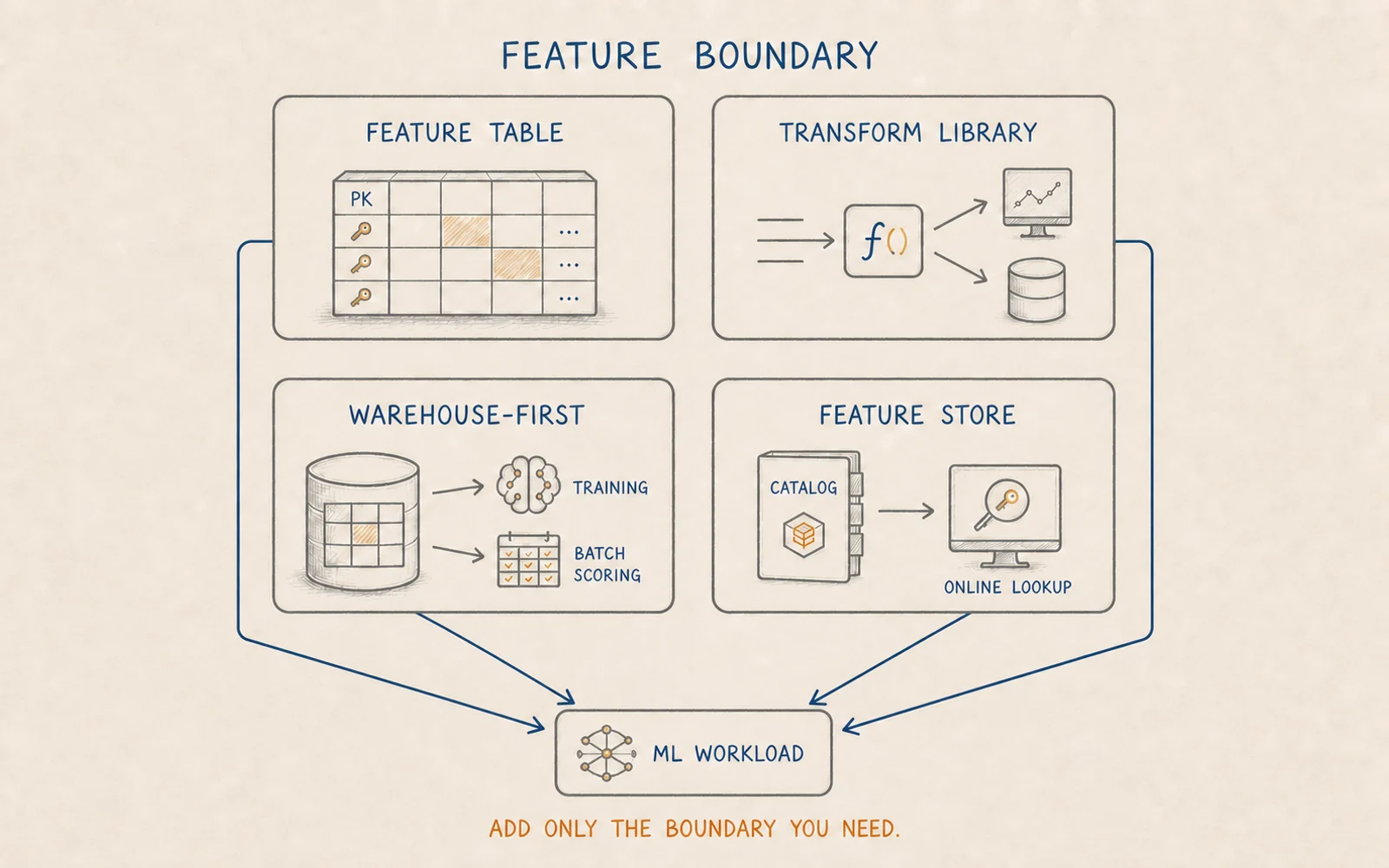
A production ML system needs reliable feature definitions, repeatable training inputs and an inference path that does not quietly change model behavior. A dedicated feature store provides those boundaries for some workloads. Feature tables, shared code and warehouse-first pipelines can provide them for others.
There are many feature store alternatives that keep the feature contract explicit without adding an online serving surface, catalog workflow and materialization lifecycle before the workload needs them. In my work, I usually start with the smallest pattern that preserves semantic definitions, historical correctness and ownership.
Feature stores: what they are, when you need one, and which use cases justify them covers the feature-store decision itself. Feature store architecture: offline, online, metadata and serving boundaries covers the full architecture. This article starts earlier, with the patterns a team can run well before that boundary is necessary.
Feature store solves specific operational problems
Every machine learning model has feature engineering, even in very simple form. Each case is different, but the relevant question is whether the team needs a separate system to manage feature discovery, retrieval, materialization and serving.
Azure Machine Learning documentation clearly outlines the scope for a typical feature store. It provides feature specifications, materialization, point-in-time retrieval, monitoring, security and feature reuse. Those capabilities address real operational problems. But they also introduce assets, schedules, permissions and failure modes - everything that someone needs to operate.
While deciding whether to use a feature store or not, I usually start from the production pressure instead:
| Pressure point | A lighter pattern can work when | A Feature store boundary becomes useful when |
|---|---|---|
| Reuse | One team owns a small set of features for one or two models | Several teams need to discover, trust and evolve common definitions |
| Historical training data | The pipeline can produce an explicit, reproducible snapshot | Point-in-time joins and leakage prevention are difficult to implement consistently |
| Batch inference | Consumers read governed tables on a schedule | Models need a reusable retrieval contract across many pipelines |
| Online inference | No request needs a low-latency lookup, or a narrow projection is enough | Multiple endpoints need fresh keyed features with consistent lookup behavior |
| Ownership | Data and ML code change together in one repository | Definitions, consumers, freshness and serving responsibilities need a shared operating model |
There are many alternatives that are lighter and target a narrower set of operational needs. The patterns described below avoid platform complexity when the workload has no consumer for it.
Feature tables are a strong default for materialized features
A feature table is a governed table at a useful entity grain. It has a stable key, a semantic definition and enough history for its consumers. For many batch ML workloads, that is the important part.
On Azure Databricks, any Unity Catalog Delta table with a primary key can serve as a feature table. That matters because it avoids a false choice between ordinary data engineering and feature engineering. A well-designed Delta table can be a feature asset without first becoming a separate platform project.
For example, a daily customer feature table might hold attributes used by a churn model:
CREATE TABLE ml.features.customer_daily (
  customer_id BIGINT NOT NULL,
  feature_date DATE NOT NULL,
  orders_30d BIGINT,
  support_tickets_90d BIGINT,
  days_since_last_order INT,
  CONSTRAINT customer_daily_pk PRIMARY KEY (customer_id, feature_date TIMESERIES)
);
Its value comes from clear grain, keys, refresh contract and source lineage. A training pipeline can create an as-of dataset from it. A batch scoring pipeline can resolve the same definitions for a known scoring date. The team can test and backfill it like any other data product.
One thing to remember is that in Unity Catalog, primary-key constraints are more informational rather than enforced. They make the entity contract visible to feature tooling and consumers, but they do not prove that a write contains one row per customer_id and feature_date. To avoid issues, its better to keep duplicate-key, null and valid-time checks in the feature pipeline.
Databricks supports time-series feature tables and point-in-time retrieval through its Feature Engineering APIs. Use that capability when the training set needs historical lookup semantics. Do not declare a time-series key only because the table is refreshed daily. The timestamp must represent the time at which the feature was valid for the entity.
A transformation library keeps shared logic close to code
There are some features that should start as tested transformation code rather than persisted tables.
Think about a case, when the same logic creates a training dataset and a batch-scoring dataset, but materializing every intermediate result would create more tables than consumers. In such cases, the library should own the definition and a pipeline should decide whether a particular consumer needs a materialized result.
A sample code snippet for a shared transformation library might look like this:
from pyspark.sql import DataFrame, functions as F


def customer_features(
    orders: DataFrame,
    customers: DataFrame,
    as_of_date: str,
) -> DataFrame:
    recent_orders = orders.where(
        (F.col("order_date") <= F.lit(as_of_date))
        & (F.col("order_date") > F.date_sub(F.lit(as_of_date), 30))
    )

    return (
        customers.select("customer_id")
        .join(
            recent_orders.groupBy("customer_id").agg(
                F.count("*").alias("orders_30d"),
                F.max("order_date").alias("last_order_date"),
            ),
            on="customer_id",
            how="left",
        )
        .fillna({"orders_30d": 0})
        .withColumn(
            "days_since_last_order",
            F.datediff(F.lit(as_of_date), F.col("last_order_date")),
        )
    )
The as_of_date input forces the caller to state the time boundary instead of letting the function quietly use the newest source data. The same function can support offline evaluation, a batch job and a backfill, provided every caller supplies inputs that match the contract.
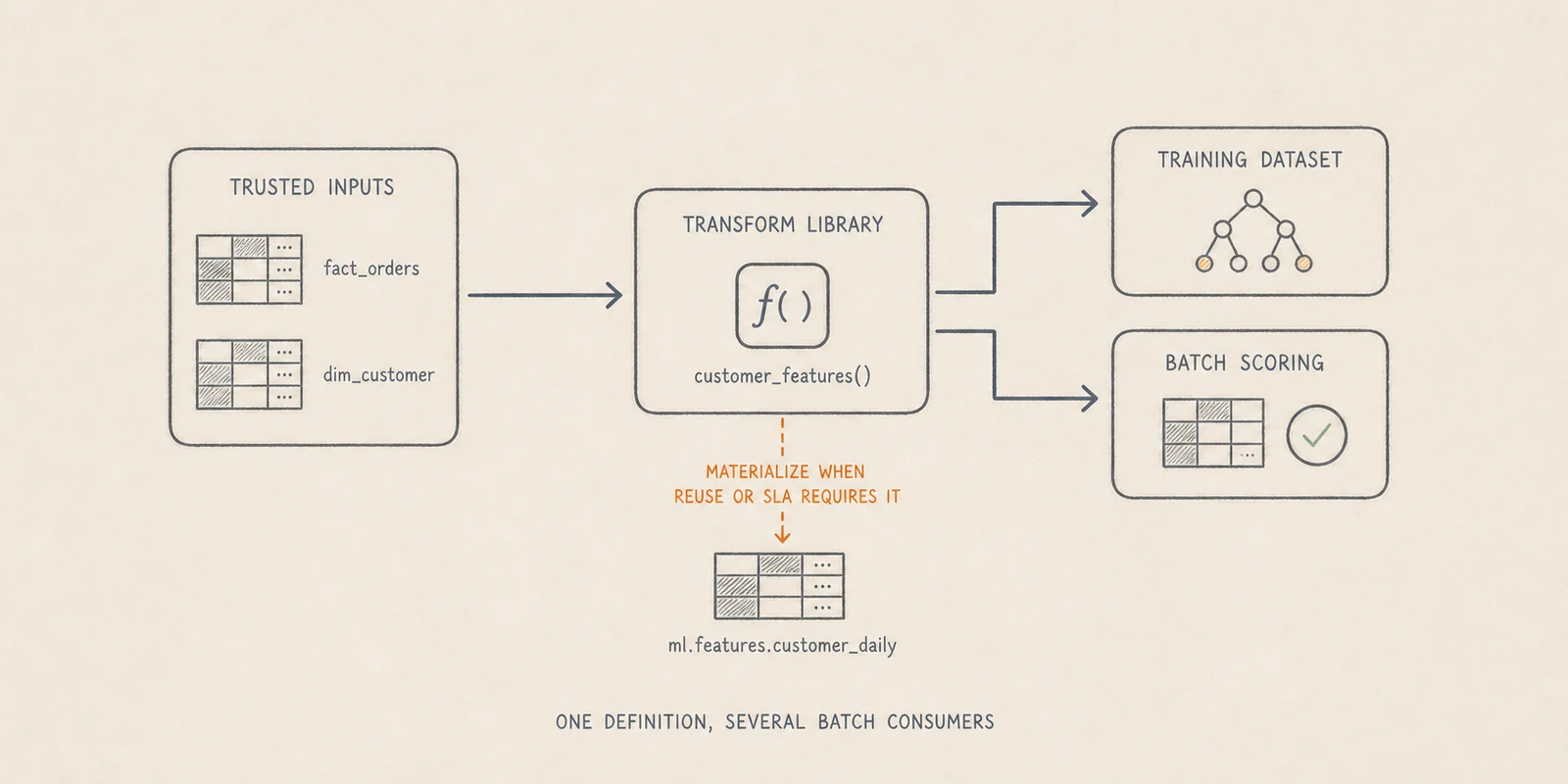
A shared transformation library keeps one definition close to code. Materialize its output when reuse, compute cost or a service-level objective makes a table worthwhile.
Unfortunately, this pattern has limits. A Python library does not give teams feature discovery, cross-workspace governance, online retrieval or automatic training-serving consistency. It also fails when two teams fork the function and change the meaning of the same feature independently.
I would rather use it for shared computation inside a bounded project. It’s usually better to promote a definition to a feature table when it becomes a durable interface for other workloads.
Warehouse-first patterns are often enough for batch ML
There is a whole set of patterns for managing features in a warehouse-first approach. The main advantage is that it keeps feature engineering inside governed data transformations and gives the ML workload an explicit, versioned data contract. It does not give a model a free pass to read whichever table happens to be convenient.
The pattern is pretty straightforward:
- Build trusted, domain-level tables such as
commerce.trusted.fact_ordersandcommerce.trusted.dim_customer. - Produce a model input table or view at an explicit grain and as-of boundary.
- Record the source snapshot, query revision and model input schema with the training run.
- Use the same contract for scheduled batch scoring, or publish a separate scoring output with a clear version.
This works well for churn, forecasting, propensity and many recommendation workloads where prediction happens hourly, daily or weekly. In such cases, the model has no reason to ask a key-value store for a value while a user is waiting.
Teams chosing a warehouse-first pattern need to be careful about how they manage their feature data. A simple join against the latest fact_orders table can leak future behavior into a training set. A warehouse-first pattern needs an explicit snapshot, a time-aware join or a reproducible training query. The architecture is lighter, but its data contract still needs the same discipline.
Online serving changes the boundary
Low-latency lookup is usually the point where many simple patterns stop being sufficient.
An online endpoint needs to answer different questions from a batch pipeline: which entity key is valid, how fresh does the value have to be, what happens on a miss, who monitors synchronization, and whether the feature returned at inference matches the feature definition used for training.
A narrow endpoint can use a small, explicitly owned online projection. A broader platform may need a feature store that joins offline history, metadata, feature retrieval and online publishing.
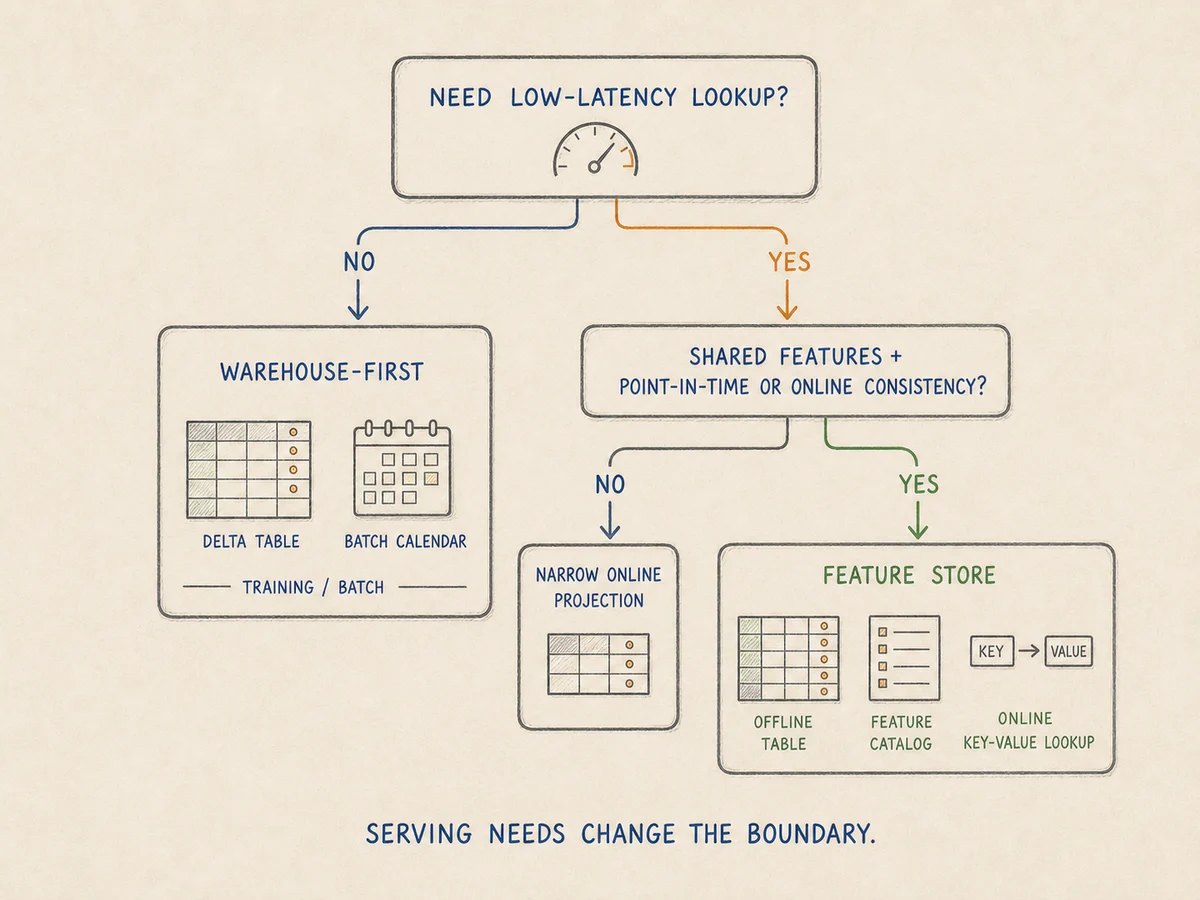
Serving requirements, not a maturity model, decide whether a batch-first feature pattern needs an online boundary.
On Databricks, feature tables in Unity Catalog can support governed discovery and lineage, while online publishing and feature lookup provide the serving path. The Feature Engineering documentation is useful here because it separates feature tables, training-set creation, model lineage and online stores instead of treating them as one indivisible product.
As always its better to keep the decision narrow. A model endpoint with two stable real-time attributes does not automatically justify a company-wide feature platform. Start with the online contract, monitor lookup latency and freshness, then expand when more consumers need the same boundary.
The contract matters more than the storage choice
The underlying storage can be Delta, a warehouse table, an online key-value store or a managed feature store. The production question stays the same: can a team explain the exact feature values that reached a model?
For every reusable feature set, I would suggest to write down:
- The entity key and grain.
- The definition and transformation owner.
- The source tables and valid-time behavior.
- The refresh cadence and freshness expectation.
- Missing-value behavior and permitted defaults.
- The consumers that depend on it.
- Whether it is batch-only, online-serving or both.
These checks connect directly to ML observability: what it means beyond model monitoring. Freshness, schema changes, lookup misses and feature distribution shifts are operational signals. They belong beside runtime and model signals, not in a separate data-quality dashboard nobody checks during an incident.
A practical feature store alternatives checklist
Start with a feature table when the output has a stable entity key, a reusable definition and a batch consumer that benefits from materialization.
Start with a transformation library when one bounded project needs the same tested logic for training, batch scoring and backfills, but a durable shared table would be premature.
Keep a warehouse-first pattern when scoring is batch-only and the team can make snapshot, point-in-time and input-schema rules explicit in the pipeline contract.
Add a narrow online projection when one endpoint needs a few low-latency values with clear ownership and freshness controls.
Adopt a full feature store when several models or teams need common discovery and lineage, safe point-in-time retrieval, and consistent online feature serving. That is the boundary where the additional lifecycle pays for itself.
FAQ
What are the main feature store alternatives?
The main feature store alternatives are governed feature tables, shared transformation libraries and warehouse-first feature pipelines. They work well when feature reuse, point-in-time joins, online lookup and serving consistency do not yet require a dedicated feature-store boundary.
Is a feature table the same as a feature store?
No. A feature table is a governed, keyed data asset that can hold reusable model inputs. A feature store adds lifecycle capabilities around that data, such as discovery, retrieval, point-in-time training joins, serving integration, online materialization and model lineage.
When is a warehouse-first feature pattern enough?
A warehouse-first feature pattern is enough for batch training and batch scoring when consumers can use governed tables or views, the input snapshot is explicit, and no low-latency feature lookup is needed at inference time.
When should a team move from feature tables to a feature store?
Move when several models or teams need shared feature discovery and ownership, point-in-time retrieval becomes difficult to implement safely, or an online serving path needs consistent feature lookup and materialization.
Further reading
- Feature tables in Unity Catalog
- Feature Engineering in Unity Catalog
- Constraints on Azure Databricks
- What is managed feature store in Azure Machine Learning?
- Feature stores: what they are, when you need one, and which use cases justify them
- Feature store architecture: offline, online, metadata and serving boundaries
- ML observability: what it means beyond model monitoring