If you are new to Databricks ML, it is easy to start in a notebook, create a job in the workspace and get a useful model result. The next question is harder: how do you make the same work repeatable, reviewable and safe to move between environments?
Databricks MLOps Stacks are a practical answer. They are an opinionated project template built on Declarative Automation Bundles. In plain terms, they put the code, jobs, configuration and environment targets for an ML workload in one source-controlled project. Rather than rebuilding that starting structure for every model, a team begins from the same delivery unit.
That is useful even before a team has a mature MLOps practice. The stack gives the first version of a project a predictable shape. Then the team can grow it around one real workload and turn the conventions that hold up into a standard for delivery, release and operations.
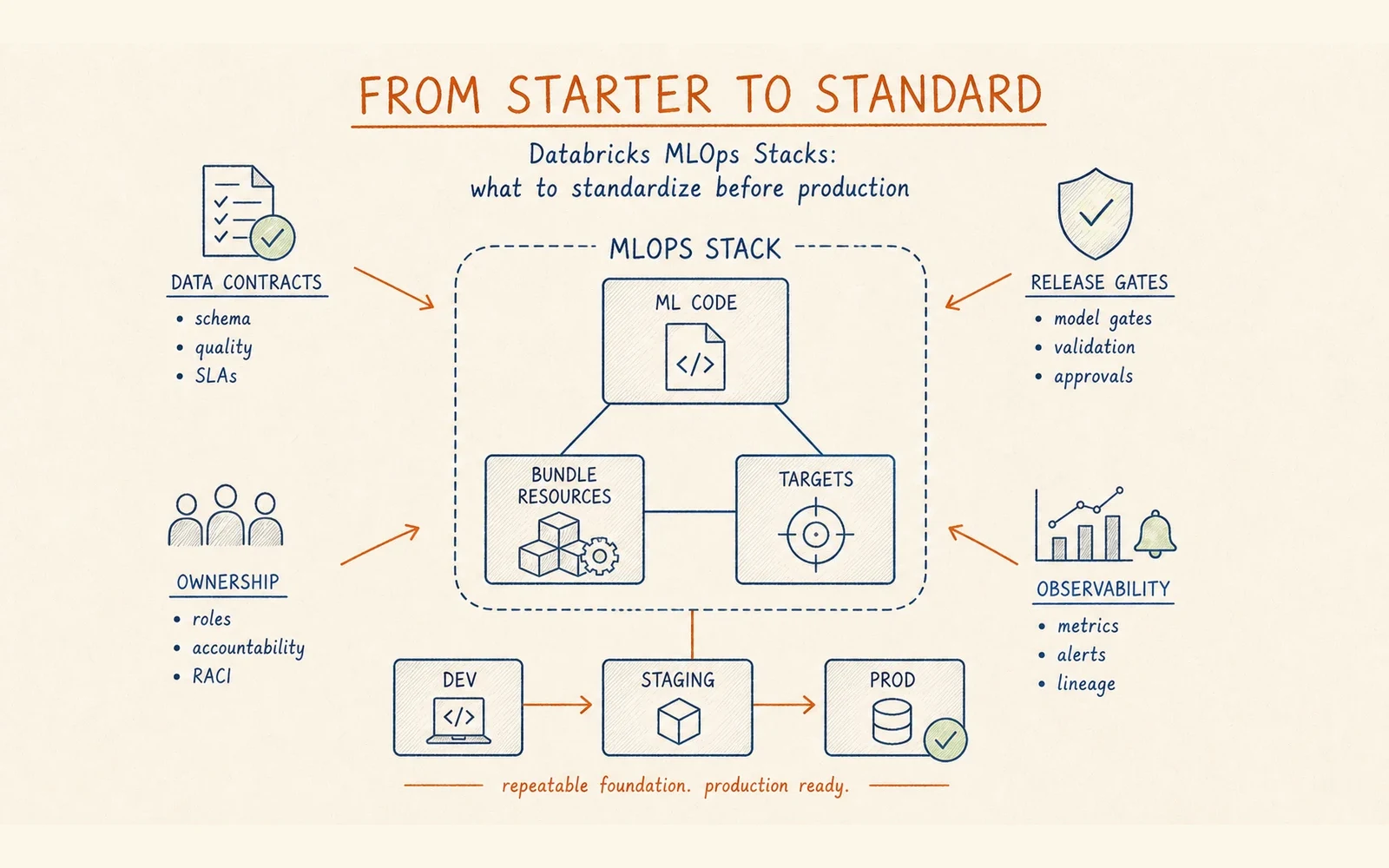
The delivery mechanics are covered in Databricks MLOps delivery patterns with GitHub Actions. This article focuses on the layer before and around that pipeline: how to use the MLOps Stacks template as a sensible baseline, and what to add as a project earns its way toward production.
Start with a working delivery unit
Databricks MLOps Stacks are built on Declarative Automation Bundles. A Bundle is the source-controlled unit that brings project code, Databricks resources and target-specific configuration together. The MLOps Stacks template adds an opinionated starting structure for machine learning delivery.
Initialize it with:
databricks bundle init mlops-stacksThe template lets a team begin with a project and CI/CD, a project only, or CI/CD only. Choose the smallest option that fits the current work. A team that is moving one existing training workflow out of a workspace does not need to solve every future platform concern on day one.
The immediate goal is simple: one repository should describe one deployable ML workload. Its production code, jobs or pipelines, resource configuration and environment targets should travel together. databricks bundle validate then gives fast feedback that the deployment definition itself is coherent before the team moves to a target.
Make one real workflow work first
The fastest way to dilute an MLOps Stack is to fill it with examples, optional jobs and half-finished workflows. Start instead with the path the team genuinely needs to operate.
For a batch model, that might be training from trusted data, evaluating a candidate, registering the result and running a scheduled inference job. For a serving use case, it may be training, evaluation, deployment to an endpoint and a controlled smoke test. The exact path changes, but it should be recognizable in the repository and easy to run in a development target.
This is also the right point to make the code boundary explicit. Keep exploration in notebooks where it is useful. Move transformations, feature logic, evaluation and inference behavior that matter in production into importable, testable modules. A notebook can remain a useful entry point; it should not be the only place where the system’s business logic exists.
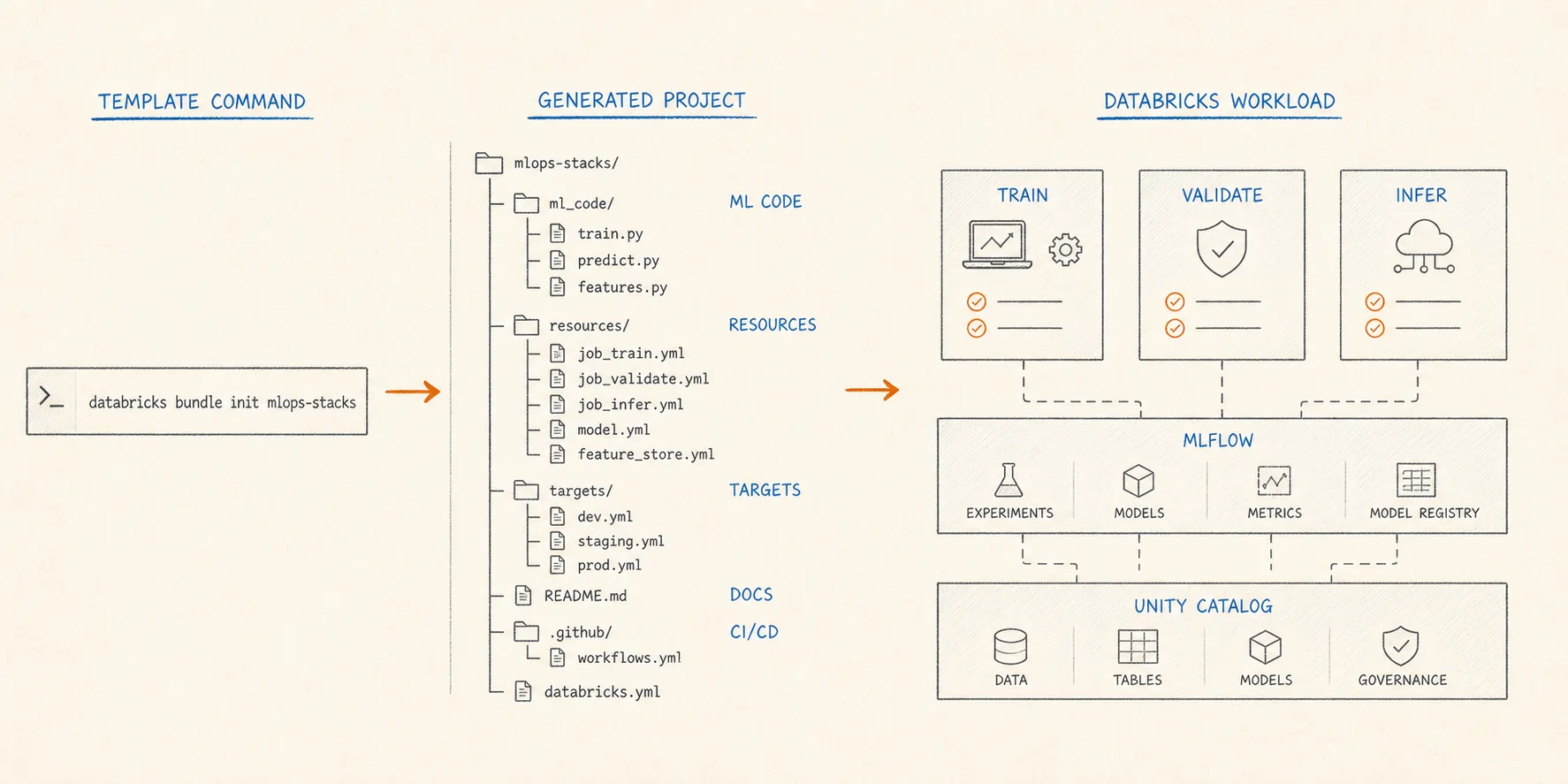
MLOps Stacks give a project its first source-controlled shape: code, resources, targets and a workload that can be trained, validated and run again.
Once the first workflow works, the template becomes a useful place to capture the decisions that would otherwise stay in deployment scripts, workspace configuration or somebody’s memory.
Turn the starter into a team standard
The standard should grow from the workload, not from a checklist copied from another team. Three areas usually deserve attention early.
Make the project boundary clear
The project should own the resources that change with its ML workload: training and inference code, jobs, pipelines, serving configuration where relevant, project tests and target settings. That is the workload delivery contract.
Shared foundations belong elsewhere. Workspace topology, network controls, central identity foundations and broad Unity Catalog administration have different owners and a different change cadence. Keeping that boundary clear prevents each ML repository from becoming a competing definition of the platform.
This does not stop a Bundle from referring to a catalog, schema or permission it needs. It keeps the project focused on the workload rather than silently taking ownership of all the infrastructure around it.
Make data dependencies and release evidence visible
Production ML depends on data products with an explicit grain, schema, freshness expectation and owner. A model project may read commerce.trusted.fact_orders and commerce.trusted.dim_customer; it should document those dependencies and decide what happens when a contract is not met. It should not quietly absorb responsibility for the source system or the data product’s recovery process.
The same applies to a model candidate. MLflow tracking and registration preserve useful evidence about an artifact, but a release needs criteria for the workload: baseline metrics, relevant slices, input checks and a runtime verification. Databricks’ MLOps workflow guidance frames code, data and model assets as separate concerns that move through controlled environments. That is a far more useful model than treating a successful deployment command as the whole release decision.
For the data side of the boundary, medallion architecture for engineers explains why trusted inputs need clear contracts and recovery paths. Where teams need features shared between models or online serving, a feature store may provide the right additional boundary.
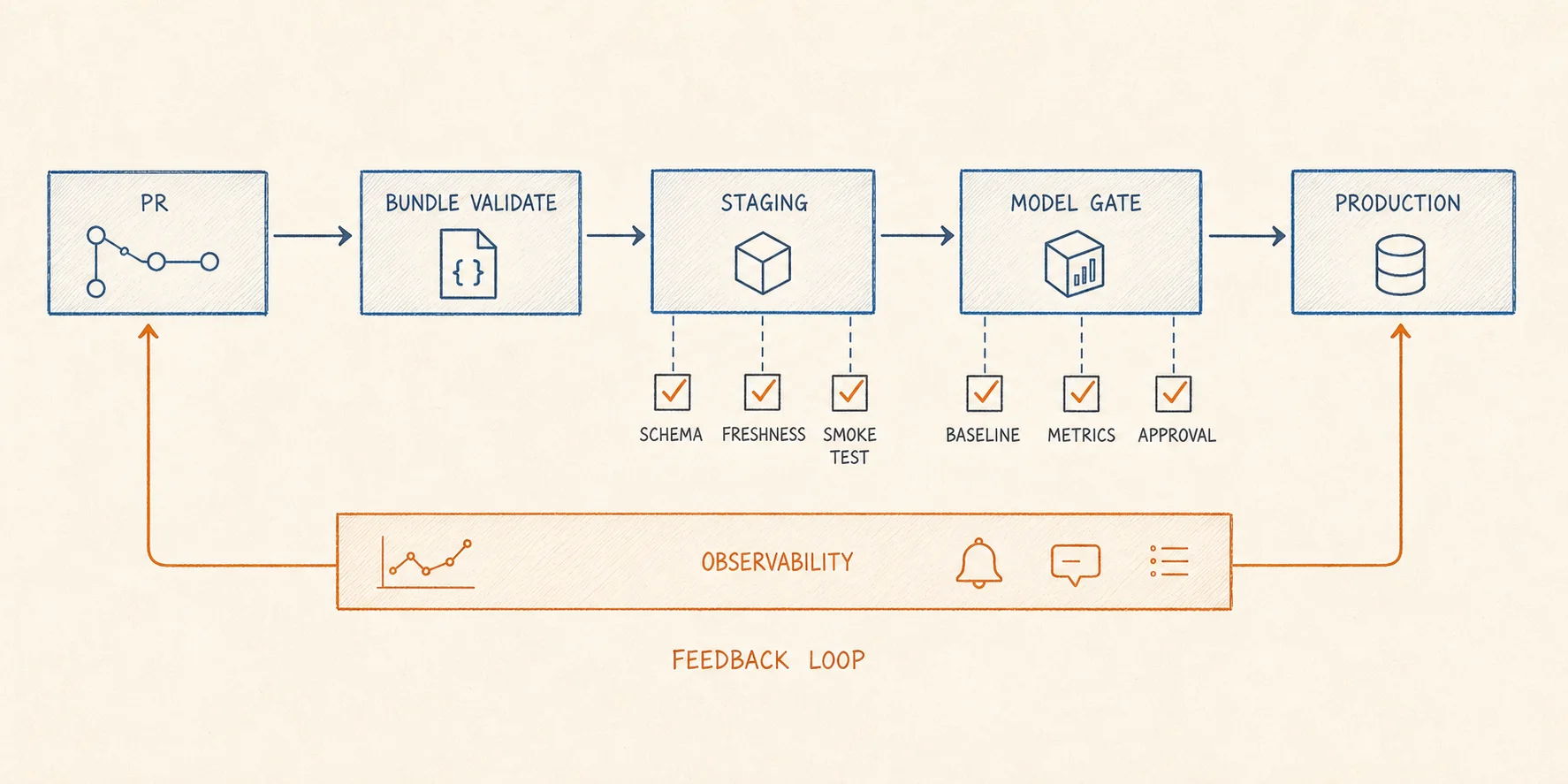
Bundle validation and deployment establish the delivery path; schema, freshness, smoke tests, metrics and approval make the production release decision explicit.
Make environment targets mean something
Development, staging and production targets are useful when they change real operating conditions. A staging target should exercise representative data contracts, access patterns and runtime identities. A production target should use the catalog boundaries, credentials and downstream dependencies that the workload will actually see.
A target that only points at a different workspace offers limited confidence. Put the assumptions beside the target configuration: which data products it reads, what it can write, which identity performs deployment, which identity runs the workload, and how the team validates the result.
Add operations before the first incident
The generated project cannot know who responds when a shared table arrives late, a runtime identity loses access or a prediction job produces an unexpected volume. Those decisions belong to the team operating the workload.
At minimum, record an owner for the training and inference paths, the data dependencies, the deployment and runtime identities, the release decision and the alert response. Then establish a small set of operational signals: job state and duration, input freshness and volume, model version, code revision, output volume, and endpoint errors or latency when serving is involved.
This is a manageable first layer of ML observability. It gives the team enough context to investigate a failed or surprising run before late-arriving business labels make model-quality monitoring possible. Minimal viable ML observability covers that operational baseline in more detail.
A practical implementation order
For teams introducing Databricks MLOps Stacks, a sensible progression looks like this:
- Initialize the smallest template option that fits the current work.
- Put one real training and inference workflow behind source-controlled code and Bundle resources.
- Define development, staging and production targets around actual identities, data contracts and dependencies.
- Add the release evidence that matters for that workload: data checks, model criteria and a runtime verification.
- Record ownership, operational signals and a recovery path, then reuse those conventions in the next project.
The result is intentionally incremental. It creates a standard because the team has used it, tested it and refined it around real delivery work.
FAQ
What are Databricks MLOps Stacks?
Databricks MLOps Stacks are a Declarative Automation Bundles template for starting production-oriented ML projects. They provide a repeatable project shape for ML code, Databricks resources, environment targets and optional CI/CD, which teams adapt to their own workload and operating model.
Where should a team start with Databricks MLOps Stacks?
Start with one real workflow rather than enabling every generated component. Make that path deployable to development, then add meaningful target boundaries, release evidence, ownership and observability as the workload moves toward production.
Do Databricks MLOps Stacks replace a team’s MLOps standard?
MLOps Stacks provide a strong delivery starter. A team standard adds the workload-specific decisions: authoritative data inputs, release criteria, runtime identities, ownership, monitoring and recovery. That work becomes easier once the starter has given the team a shared project shape.
Final point
The value of Databricks MLOps Stacks is that they make the first production-minded decision easy: start from a deployable, source-controlled project instead of inventing a structure around every new model.
From there, keep the progression concrete. Prove one workflow. Add controls where the workload needs them. Reuse the decisions that continue to hold up under delivery and operations. That is how a template becomes a dependable MLOps standard without turning the first project into a platform redesign.
Further reading
- Databricks MLOps Stacks
- Declarative Automation Bundles templates
- MLOps workflows on Azure Databricks
- Azure Databricks machine learning capabilities
- Databricks MLOps delivery patterns with GitHub Actions
- Medallion architecture for engineers
- Feature stores: when you need one and when you don’t
- Minimal viable ML observability: what to monitor first